For Enhanced Mobility
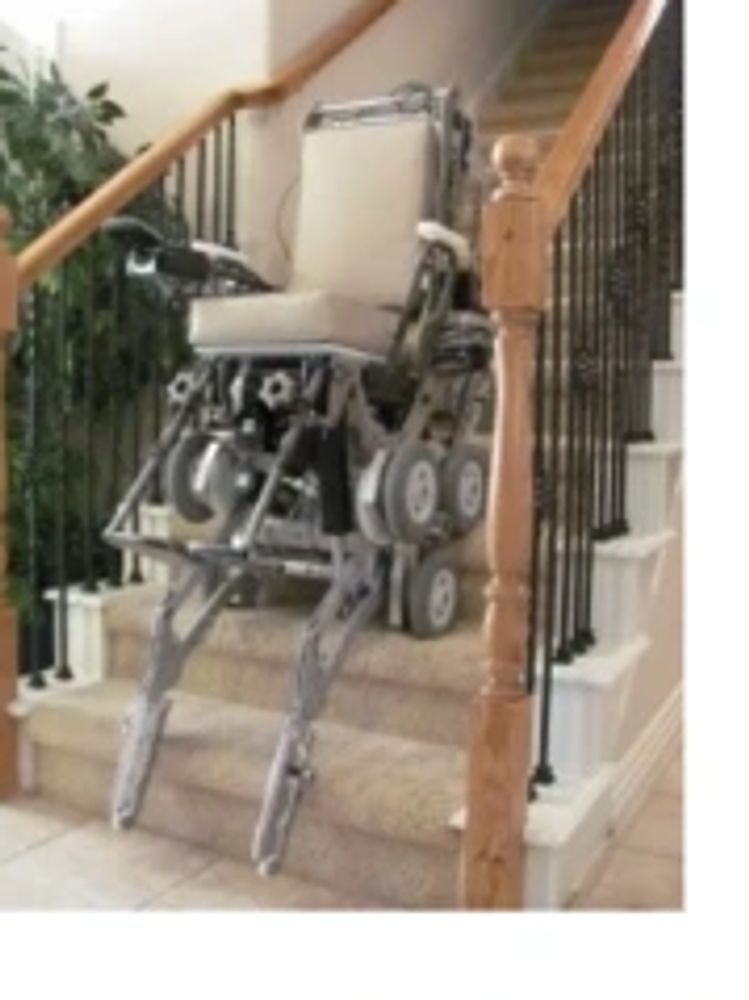
Where would you go if your wheelchair could climb stairs?

The StairMaster Wheelchair™ includes level operation, stair-climbing, and slope-climbing. Operation on level ground is similar to the operation of a conventionally powered wheelchair. The wheelchair accommodates stair steps of different riser heights and different tread lengths. It can accommodate stair angles typically found in homes. See the table for performance goals. See the Stair-Climb Video for stair-climbing sequence. See the FAQ for more information.
Hand rails or an attendant are not needed for balancing on stairs or steps. The wheelchair balances itself. We are developing a powered wheelchair to replace an ordinary wheelchair and provide significantly improved access to homes. The operation is simple: speed control and direction are with a joystick. The control system selects the correct operation phase based on sensors that detect steps and slopes. The StairMaster Wheelchair can accommodate CRT (complex rehab technology) controls and seating, including seat tilt, recline, height adjustment and head rest. You can travel outside on driveways, and sidewalks with steps, curbs and steep slopes. A van can be accessed with steps rather than a lift. Or the wheelchair can be carried on a rear bumper rack or pick up bed by adding steps.
The wheelchair decides when to level the wheelchair, extend the skids, rotate the spider or drive the wheels. You decide where to go and operate the joy-stick to control the direction and speed. The wheelchair aligns itself to stair riser edges and keeps the wheels crowded securely against the risers.
If the wheelchair encounters a step too high or stairs too steep, the wheelchair will stop motion in that direction and then can retreat.
If the battery loses power, the wheelchair locks up and is securely balanced on the stairs. All motion is halted and all functions are locked when the joy-stick is released or power is switched off.
Even with the added stair climbing ability, the wheelchair would not be suitable for many homes without accommodating narrow doorways and tight turning spaces. This wheelchair is only 22" wide and turns about its own center.
The StairMaster Wheelchair is not yet on the market. The development and required FDA approval are likely to be a lengthy process. We are interested in your comments. Encouragement from potential customers would be helpful to get StairMaster, potential research grant providers and investors to commit funds to developed and produce the wheelchair. Watch this site for a chance to complete a survey to show your support and enter a drawing for a gift card. Sales of the StairMaster will only be after testing and FDA premarket approval is granted. Watch this website for information on sales.
Check out a paper at RESNA (Rehabilitation Engineering and Assistive Technology Society of North America) in 2014 on the Stairmaster Wheelchair.
https://www.resna.org/sites/default/files/conference/2014/Wheeled%20Mobility/Cox.html
Ken Cox, the owner, is a landing gear design engineer who was looking for a week-end design project in 1978. He remembered the need for a stair-climbing wheelchair and decided to try that. StairMaster Wheelchair was formed in 1981 to prepare his stair-climbing wheelchair for the marketplace. After numerous design iterations, he designed a spider wheel type, manually operated, folding, stair-climbing wheelchair. He fabricated a manually powered demonstrator to prove the climbing concept and patented it (US Patent 4,512,488). He was awarded a Phase I NIH SBIR grant to develop a stair-climbing wheelchair in 1986. Wheelchair users met with him during the grant effort and requested a powered wheelchair suitable for home use. Ken changed the design. He patented (US Patent 6,484,829), and has built a prototype battery-powered stair-climbing wheelchair that is intended to meet the goals of the review comments.
Mr. Cox received a Bachelor of Science degree in mechanical engineering from Texas Tech University in 1965. A registered professional engineer in the state of Texas, PE 34572, he has more than 41 years' experience in designing mechanical equipment, including landing gear for naval carrier based aircraft. Ken is now retired and works full time on the project. Ken has recently joined RESNA's Wheelchair Standards Committee.
Ken is not in a wheelchair and encourages others who are to guide him in developing a wheelchair that will be useful to them.
We use cookies to analyze website traffic and optimize your website experience. By accepting our use of cookies, your data will be aggregated with all other user data.